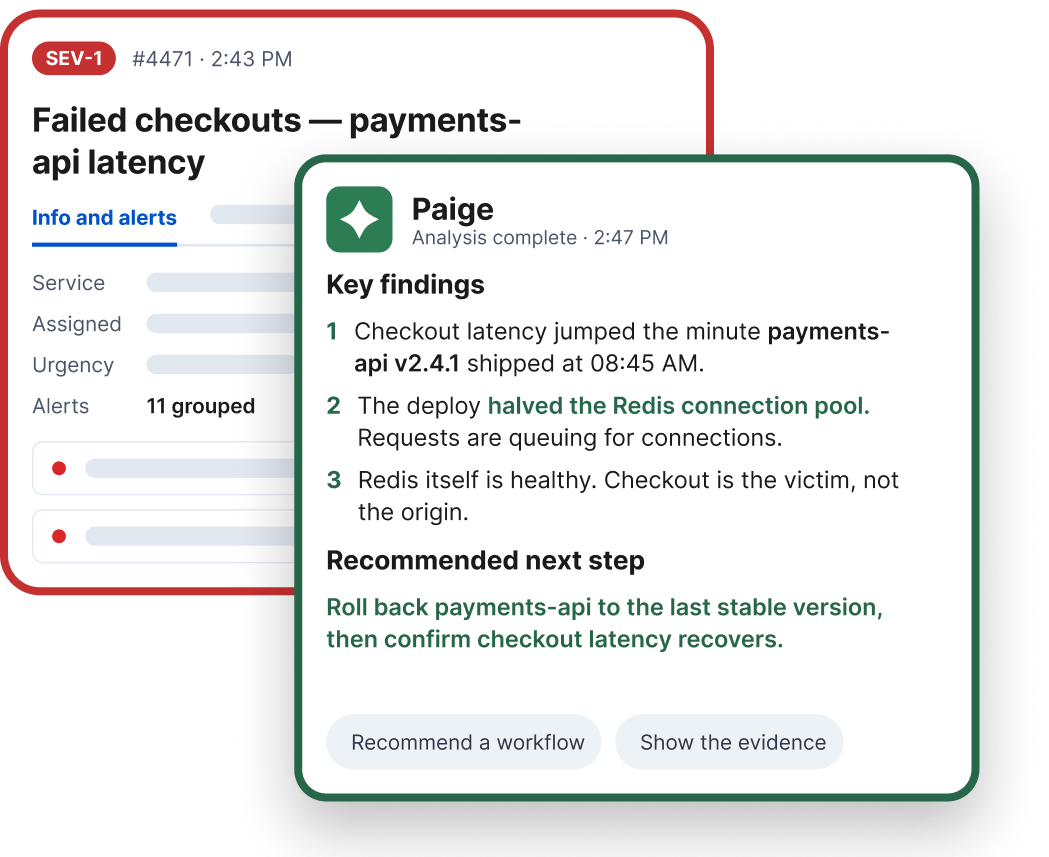
PagerDuty introduced Paige and its PD Reliability Platform on November 3. The SRE agent uses incident history, logs, documentation, runbooks and service context to investigate problems, recommend remediation and support post-incident review.
Diagnosis uses operational context
The company’s illustrated workflow has a service owner approve a proposed fix before Paige executes it. Teams can subsequently grant permission for known remediation patterns, making the scope of an agent’s authority part of the operating configuration.
Action permissions are explicit
PagerDuty also announced PD Labs experiments for service topology, parallel hypothesis testing and a shared SRE workbench. Those experimental tools have a different maturity level from the core launch and require evaluation within the customer’s incident process.
Experimental tools have a separate status
The practical test is whether diagnosis remains traceable as evidence changes and whether remediation permissions hold under pressure. Measurements of investigation accuracy, recovery time and unintended actions would show the effect on production reliability.
Image: PagerDuty / source announcement. Used for source-attributed editorial reporting; rights remain with the owner.
Sources & evidence
Sources describe the announcements and evidence available when this analysis was published. Company claims are attributed; plans and trials are not treated as sustained operation.